News
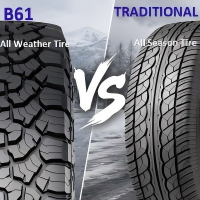
The debate between B61 all weather tire vs all season tire options reflects a larger shift occurring throughout the tire industry. For decades, all season tires were the default choice for many drivers. Today, however, advances in tire technology have led to the rapid growth of the all weather category.
The Landpioneer B61 represents this new generation of tire design, offering a combination of wet traction, cold-weather adaptability, and everyday comfort that many drivers now expect from a year-round tire.
The Traditional All Season Tire Limitation
Why Low Temperatures Affect Grip
Rubber compounds behave differently as temperatures change.
Traditional all season tires are often optimized for moderate climates. When temperatures fall, the rubber can become stiffer, reducing the tire’s ability to conform to road surface irregularities.
As a result, traction may decrease, particularly during cold mornings or sudden weather changes.
The Weakness of Conventional Tread Design
Many conventional all season tires were developed primarily for dry-road comfort and long tread life.
Although they generally perform well in everyday driving, they may feature:
* Fewer sipes
* Less aggressive water evacuation channels
* Reduced snow traction capability
These characteristics become more noticeable during adverse weather conditions.
Head-to-Head Performance Comparison
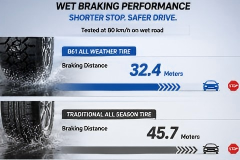
Wet Road Braking
Wet braking is one of the most important safety indicators.
The B61 utilizes a modern tread design featuring multiple drainage channels and extensive siping. These features help evacuate water efficiently and improve contact with the road surface.
Many traditional all season tires provide acceptable wet performance, but modern all weather designs often deliver stronger grip during heavy rain.
Cold Weather Stability
One area where all weather tires frequently show advantages is temperature adaptability.
The B61’s compound is engineered to remain flexible over a wider temperature range, supporting more predictable handling when temperatures drop.
Light Snow Capability
Light snow is common in many regions where drivers do not want to maintain separate winter tire sets.
The B61’s tread architecture and compound technology help improve traction in these conditions compared with conventional all season products.
Gravel and Dirt Road Performance
The B61’s more aggressive tread pattern also provides additional traction on gravel roads and light off-road surfaces.
This makes it attractive for SUV and crossover owners who enjoy occasional outdoor activities.
Why Modern All Weather Tires Have Evolved
Advanced Rubber Compound Technology
One of the most significant developments in tire engineering involves rubber compound formulation.
Modern all weather compounds often incorporate:
* Silica-enhanced materials
* Temperature-adaptive polymers
* Improved wet-grip chemistry
These technologies help maintain performance over a broader range of weather conditions.
Improved Groove and Siping Design
Tread engineering has also advanced significantly.
The B61 incorporates:
* Multiple water evacuation channels
* High-density siping
* Optimized tread block arrangement
Together, these features help improve traction in rain, cold temperatures, and light snow.
For more information on tire compound technology, see: Rubber Compounds in All Weather Tires Explained.
Who Should Consider Upgrading?
Drivers in Variable Climates
Drivers who regularly experience changing weather conditions throughout the year may benefit most from all weather tire technology.
SUV and Crossover Owners
SUVs and crossovers are frequently used for a wide range of activities, from commuting to weekend travel.
A versatile tire such as the B61 can support these mixed driving demands effectively.
Users Tired of Seasonal Tire Changes
Many vehicle owners prefer reducing maintenance complexity.
An all weather tire can help eliminate the inconvenience associated with seasonal tire swaps.
Conclusion
Why the B61 Represents a More Modern Solution
The tire industry continues to evolve, and modern all weather tires are a reflection of changing driver expectations. Consumers increasingly want a single tire capable of handling rain, cold temperatures, light snow, and everyday commuting.
The Landpioneer B61 was developed specifically to address those needs.
Choosing Practical Performance Over Old Limitations
Traditional all season tires remain a useful option in many environments. However, for drivers seeking stronger wet traction, better cold-weather adaptability, and greater year-round versatility, the B61 offers a compelling alternative.
Related Articles
*How All Weather Tires Like the B61 Perform in Rainy and Slippery Conditions*
*Can One Tire Really Handle All Seasons? Real-World Driving Insights on the B61*
*All Weather vs All Season vs All Terrain Tires: A Comprehensive Guide*
For additional consumer tire education resources, visit the Tire Industry Association (TIA).