News

When researching all weather tires, one question comes up quickly: how can a single tire perform reliably across heat, rain, and cold conditions? The answer lies in the rubber compounds in all weather tires, which are specifically engineered to adapt to temperature changes without sacrificing grip or durability.
These tires promise something that sounds almost impossible: stable traction on sun-baked asphalt, confident braking on wet roads, and flexibility on cold mornings. Behind that promise isn’t magic—it’s material science. The tread compound works like a carefully balanced recipe: get it slightly wrong, and performance drops sharply; get it right, and the tire quietly adapts to every season.
Why Rubber Compounds Are Critical in All Weather Tires Performance
When the weather turns, the rubber in your tires reacts before you do. That invisible chemical reaction is what determines if you’ll stop in time or slide through an intersection. This is exactly why all weather tires rely heavily on advanced rubber compounds to maintain consistent performance across changing environments.
The Seasonal Struggle: Summer vs. Winter Rubber
A summer tire is designed for warm roads. Once the temperature drops below around 7°C (45°F), the rubber starts to stiffen. At a microscopic level, the long polymer chains lose their ability to wiggle and conform to tiny bumps in the road. The result? A tire that behaves more like a hard plastic puck than a grippy safety device.
A winter tire, on the other hand, is chemically engineered to stay soft and pliable in freezing conditions. But drive that same soft winter rubber through a hot summer, and it wears down as quickly as a pencil eraser, while also feeling squirmy and imprecise in corners. You get a short lifespan and a disconnected steering feel.
The Goldilocks Zone of All Weather Tires
An all weather tire like the Landpioneer B61 lives in the “Goldilocks” space between those two extremes. Its compound is designed so the glass transition temperature – the point where rubber goes from flexible to glass-like – sits well below the coldest morning you’re likely to face, yet the rubber remains stable and tough enough to handle high heat highway driving. This isn’t achieved with a single miracle ingredient, but rather a carefully balanced blend of materials working together.
The Role of Silica in All Weather Tires: Improving Wet Grip and Reducing Rolling Resistance
If there’s one ingredient that fundamentally changed what all weather tires could do, it’s silica. Not the little packets you find in a shoe box to keep things dry, but a highly engineered form of silicon dioxide that is mixed directly into the tread compound.
What Exactly is Silica?
In the past, tire makers relied heavily on carbon black – a material that reinforces rubber and gives tires their black color. Carbon black does a great job of improving wear resistance, but it comes with a trade-off: it tends to increase rolling resistance, which hurts fuel economy, and it doesn’t do much to improve grip on wet roads. Silica, when dispersed correctly, changes that equation completely. It strengthens the rubber, but in a way that allows the tread to flex microscopically. At the molecular level, silica particles act almost like tiny, flexible ball bearings that let the compound deform and recover without building up excessive heat.
A Molecular Glue for Grip and Efficiency
What makes silica truly special is how it interacts with water. On a rainy road, a thin film of water tries to separate the tire from the asphalt. Silica filled compounds have a unique chemical “stickiness” that helps break through that film, allowing the tread blocks to contact the road more directly. This is where material science meets tread design. We break down that precise interaction – how the rubber and the tread pattern work together to keep you safe on wet roads – in our detailed look at the B61’s water evacuation system.
At the same time, because silica reinforced rubber doesn’t waste as much energy as it flexes, rolling resistance drops. For a driver, that means you’re not just stopping shorter on wet roads – you’re also burning slightly less fuel over every mile. In fact, according to reports from the European Tyre and Rubber Manufacturers Association (ETRMA), the widespread adoption of silica technology has been one of the biggest contributors to reducing tire-related fuel consumption across the industry over the last two decades. The B61’s tread compound uses this silica technology so that wet‑weather safety and everyday efficiency aren’t enemies; they’re baked into the same recipe. For modern all weather tires, silica has become a core material that enables both safety and fuel efficiency without compromise.
Polymer Blends in All Weather Tires: Maintaining Flexibility from -10°C to 40°C
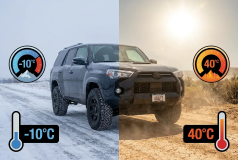
Silica alone isn’t enough. To build a tire that stays consistent whether the mercury shows -10°C or 40°C, the very backbone of the rubber – the polymer – needs a custom tune-up.
The Magic of Custom Polymer Blends
Think of the polymer as the flour in your cake. Different flours make drastically different cakes, even if you use the same oven. In a tire, chemists blend multiple synthetic polymers, each with its own natural temperature preferences. One polymer might be naturally flexible in the cold, while another resists heat and abrasion. By linking them together at the molecular level, engineers create a hybrid backbone with a much wider comfort zone. The B61’s recipe uses this blend so that on a winter morning, the cold loving polymers keep the tread pliable, while during a highway run in August, the heat loving polymers prevent the tire from degrading too quickly.
How Resins Tune the Temperature Window
Resins are the secret spice. These molecules act as “softening assistants.” They don’t just make the rubber compound easier to process during manufacturing; they also fine‑tune how the tread responds to temperature swings. A carefully chosen resin can lower the compound’s stiffness in the cold without making it gooey in the heat – essentially widening the operational temperature window. In the B61, the resin system is balanced to help the tread feel consistent and predictable, whether you’re leaving a snow dusted driveway or pulling onto a scorching freeway on-ramp. This multi-material strategy is what allows all weather tires to function reliably across a wide temperature range.
Balancing Durability and Grip in All Weather Tires: Is There Still a Trade-Off?
Many people worry that a tire that stays soft in the cold must wear out faster. It’s a reasonable concern, because for decades there was a direct trade-off: you could have long wear or strong grip, but rarely both.
The Old Trade-off Myth
Older compound technology forced that compromise. To get high grip, you made the rubber soft, and soft rubber got chewed up quickly. To get long wear, you made the rubber hard, and hard rubber didn’t grip well, especially on cold or wet roads. That forced drivers into a mental calculation: do I prioritize safety or longevity? All weather tires were once considered a “jack of all trades, master of none” precisely because of this old limitation
Modern Solutions for Long Life and Safety
Today, that calculation no longer applies to a well engineered tire. Advanced compounding techniques – including the silica and polymer blends we discussed – allow the B61’s tread to deliver high grip on cold and wet surfaces while maintaining a wear rate that rivals a good all season touring tire. This is the core subject of our main guide, where we explain what makes the Landpioneer B61 a smart choice for year–round driving without the traditional trade-offs.
The key is in the uniformity of the compound dispersion. When the ingredients are blended with precision, the tread wears evenly, avoiding the rapid, irregular wear patterns that shorten a tire’s life. You don’t notice a compromise because the chemistry has effectively erased it.
Driving modern all weather tires, you’re not relying on a single material advantage – you’re benefiting from advanced rubber compounds in all weather tires designed for real-world conditions.
Frequently Asked Questions About All Weather Tire Compounds
What makes rubber compounds in all weather tires different?
Rubber compounds in all weather tires are designed to remain flexible in cold temperatures while maintaining stability in heat, using a combination of silica, polymers, and resins.
Do all weather tires perform well in winter?
Yes, all weather tires are engineered to handle mild to moderate winter conditions, thanks to their temperature-adaptive rubber compounds.
How does silica improve tire performance?
Silica improves wet grip and reduces rolling resistance, making all weather tires safer and more fuel-efficient.
Are all weather tires durable?
Modern all weather tires are designed to balance grip and wear resistance, offering long service life alongside reliable traction.